
The Solar Tariff Deadline Is Coming. Here's What Homeowners and Installers Sourcing Stateside Actually Need to Know

If you're a homeowner planning a system, or an installer who buys through U.S. distributors and third-party sellers, the December 4 Section 232 solar tariffs probably sound like someone else's problem. You're not importing containers from Asia. You're buying from a warehouse in your state. How bad could it really get?
The honest answer: the tariff itself isn't your problem. The replacement cost of the panels you buy is. And that cost is about to move in a way that matters for your quote, your margin, or your project timeline—even if you never touch a customs form.
Here's what's actually changing, what it means for a residential job, and what you can still do about it before the window closes.
What Happens on December 4
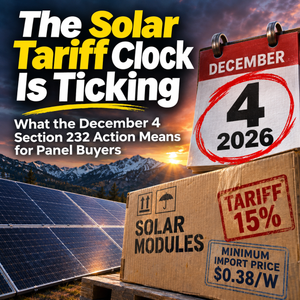
The Section 232 proclamation sets a minimum import price of $0.38 per watt** on imported solar modules, plus a **15% tariff** on most countries. The floor applies at the border, before any distributor markup. For the past few years, distributors have been buying panels for roughly $0.30 to $0.40 per watt. Once the floor and tariff stack, distributors expect pricing to settle around **$0.50 per watt.
That's not a 40% jump in your project cost. It's a jump in one component. Panels typically make up only about 12% of a residential installation's total cost. The rest is labor, racking, inverters, permits, and overhead—none of which is imported polysilicon.
A typical 10-kilowatt system priced between $25,000 and $30,000 might see roughly a **$2,000 increase** from a $0.20-per-watt rise in panel costs. That's about 7 to 8 percent, not 40. Meaningful, but not catastrophic.
Why "Made in USA" Doesn't Save You
This is the part that catches people off guard. Most American panel factories assemble modules from imported solar cells. The cells are covered by their own $0.22-per-watt floor and the 15% tariff. So even a panel stamped "assembled in America" is about to get more expensive.
Anza estimates U.S.-assembled panels using imported cells will rise from about $0.30 to **$0.43 per watt**. Fully domestic panels, with U.S.-made cells, run closer to $0.47 per watt today—which happens to land just above the new import floor. The tariff architects designed it that way.
For installers, this means the cheap domestic-content option you've been using as a fallback isn't a fallback anymore. The gap between imported and domestic narrows, but both go up.
The Real Risk for Installers: Your Signed Backlog
If you're an installer who sources from stateside distributors, your exposure isn't in new quotes. You'll price those with the new numbers. Your exposure is in deals you already signed that install after December 4.
Here's the math that should worry you. An 8-kilowatt system at $2.90 per watt is a $23,200 contract. If your module cost rises by $0.10 per watt between signing and installation, that's $800. At a 10% net margin—$2,320—that $800 eats about one-third of your profit on the job. One job. One timing gap.
Distributors still have pre-tariff inventory in warehouses. One industry webinar estimated that old-price stock could stretch from December 4 to late January or early February, depending on how fast it moves. But once it's gone, it's gone. The anti-stockpiling rules capped how much new inventory could enter the country before the deadline—new importers were limited to just 55 modules per week, roughly enough for two homes.
If you have signed contracts installing in Q1 2027, talk to your distributor now about price-validity windows and substitution clauses. Don't assume the quote you got in October will hold through January.
For Homeowners: The Window Is Real, But Closing
If you've been considering solar, the next few weeks are genuinely the cheapest window you're likely to see for a while. Not because the tariff directly doubles your price—it doesn't—but because pre-tariff inventory is finite and not being replenished at the old cost.
A system installed this fall or early winter, using panels that entered the country before December 4, avoids the new floor entirely. A system quoted in spring 2027 will not.
A few things to keep in mind as you evaluate quotes:
Ask where the panels are coming from. Your installer may not know the country of origin offhand, but they should know whether their distributor is still selling pre-tariff stock. If the answer is "we have plenty," ask how long that's expected to last.
Don't panic about the headline number. If a salesperson tells you solar is about to get 40% more expensive, they're conflating panel price with system price. The real impact on a full installation is much smaller.
The federal tax credit picture has changed too. The residential 25D credit expired at the end of 2025 for homeowner-owned systems. Third-party ownership structures (leases and PPAs) can still access commercial credits, which is why some installers are steering customers toward TPO options. That's a separate calculation from the tariff, but it affects the same bottom line.
What to Do Before December 4
If you're an installer: Audit your signed backlog. Flag every job installing after December 4 that was quoted at pre-tariff module costs. Call your distributor and ask what their price-validity policy is for Q1. If you have jobs where the margin is thin, consider whether a substitution clause or a re-quote conversation with the homeowner is warranted before the calendar turns.
If you're a homeowner: Get quotes now, and ask specifically whether the installer can lock in pre-tariff panel pricing. If you're comparing a lease versus a purchase, ask how each structure handles equipment cost changes between signing and installation. The answer might affect which option makes more sense for your timeline.
The Section 232 tariffs aren't a cliff edge for residential solar. They're a cost floor that's rising under everyone's feet—importers, distributors, installers, and homeowners alike. The people who navigate it best will be the ones who understood that the floor was moving before they signed on the dotted line.
- Loren Geist