
Solar Panel Store Blog
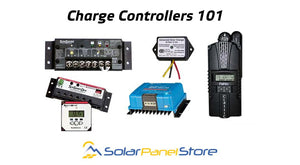

Charge Controllers 101
Do you need a solar charge controller?
If your solar PV system will require batteries, then YES! If not, you can skip right on by this page. Why? Because solar charge controllers control or regulate the charging of batteries in a battery-based solar PV system. And because most residential solar electric systems are “grid-tied” systems, they do not use batteries and thus have no need for solar panel controllers. But all the off-grid homes and remote equipment power by solar-charged battery systems (lights, sensors, instruments, etc.) need charge controllers to safely and efficiently charge their battery investments.
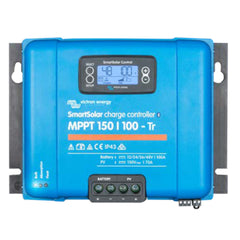
What do charge controllers do?
Didn't we just cover this? Kind of. But let's get a little more specific. You may wonder why these devices aren't just called battery chargers? Generally speaking, a battery charger refers to a device that you plug into an AC outlet and then connect to a battery to charge it. You may have one in your garage to charge the car battery when dead. A charge controller is used to regulate the voltage and current coming from a DC energy source like a solar PV array. It sometimes helps to think of these as solar charge controllers or DC charge controllers, especially if your system may also include an inverter/charger (mentioned on our Inverter page). In that case you would still need both the inverter/charger (which involves AC charging of the battery bank) and a DC solar charge controller to regulate the flow of solar DC energy into the batteries.Charge Controller - Water Faucet Analogy.
The goal in charging a battery is to bring the battery's voltage up to a factory-defined level that represents its full charge. A classic analogy will illustrate how solar charge controllers work. Imagine you want to fill a glass from a water faucet. Think of the faucet as the charge controller and the glass as the battery. The water level in the glass represents the battery's voltage level. The water flow represents the current. As long as the water level is low enough, and the flow of water slow enough, then the glass will accept more water. Just like a low battery will accept DC current. But turning the faucet wide-open will quickly overflow the glass from the force of the water flow. Similarly, without a charge controller, excessive DC current flow can overcharge the battery. But adjusting the faucet, reduces the water flow to more steadily fill the glass without spillage. Likewise, a charge controller controls regulates the DC current flowing into the battery to steadily raise the battery's voltage to effectively and efficiently re-charge the battery without causing damage.Battery Charging Set points.
More specifically, a charge controller regulates current into the battery by based on charging "set points" for that battery. Battery manufacturers specify certain voltage levels ("set points") for each of the 3 stages of battery charging. There is a set point for the bulk, absorption and float charge stages that solar panel controllers keep track of. So a depleted battery is like that empty glass. The charge controller feeds the the highest current (like the fast water flow of an open faucet into an empty glass) during the bulk stage until the voltage level rises to the bulk stage set point at which point the battery is about 80% recharged. At that point, the charge controller reduces current (or flow) like a slow-running faucet until it reaches the absorption set point. After that the charge controller basically just drips enough current to keep the battery voltage at its float set point (filled to the brim).What kind do I need?
There are two types of charge controller technology used these days. The cheaper, effective but more limited PWM or pulse width modulation charge controllers are one type. While MPPT or (maximum power point tracking) charge controllers are the more efficient and flexible, but more expensive type. On our website, you'll find PWM charge controllers under the Small Charge Controller page, but you'll find MPPT charge controllers on both the Small Charge Controller and Large Charge Controller pages. We define Small Charge Controllers to generally be those up to 30 Amps, and Large Controllers above that.
PWM Charge Controllers.
In the typical scenario, we look to see if we can simply match the voltage of the controller to your battery bank. So a 12 volt controller matches with a 12 volt battery bank/system. This is the typical situation with an RV or boat. Similarly, if you have a 24 volt battery bank for your off-grid house, you would match it with a 24 volt charge controller. Same for 48 volt systems. In these scenarios, the cheaper and perfectly good choice would be a pulse width modulation (PWM) solar panel controller. Huh? We'll explain in a minute. Contrast the PWM controller with a maximum power point tracking (MPPT) charge controller. The MPPT controllers cost more, but allow you to use a larger voltage solar panel/array with a smaller voltage battery system. So a 60 cell, 30V solar panel can charge a 12 volt battery bank when an MPPT controller is used.MPPT Charge Controllers.
An MPPT charge controller feeds the maximum amount of energy produced by the solar array to the battery bank. Voltage may vary from the solar array depending on the sun's intensity. But despite that, an MPPT charge controller can use all of the available energy to charge the batteries Why? Since watts = voltage x current, an MPPT controller can adjust the voltage to match the battery by adjusting the current. This also allows an MPPT controller to use a larger voltage solar array than the battery bank uses. So while the MPPT controllers cost more, they get more charging bang, for the solar array buck. Conversely, a PWM charge controller can only use the voltage supplied by the solar array that matches the battery bank voltage to charge the battery bank . So when panels produce more voltage in better sun and/or cooler temps, the PWM controller can only use up to its rated voltage to charge the batteries--which may mean energy wasted. Similarly, a PWM controller cannot use a higher voltage solar array (say 30 volts) to charge a 12 volt battery bank. But a PWM does a very nice job charging batteries if its voltage is in sync with the battery bank. In the same way pulsing a faucet on and off in quick small bursts get a glass of water nicely full, a PWM controller charges a battery by pulsing quick small bursts of solar energy.
Click here to see our charge controller product lines or drill down into specific types in the menu above.
- Thomas Lindberg
- Tags: charge controllers Solar Basics
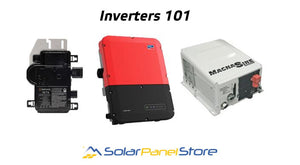

Inverters 101
Solar Inverters.
What is an inverter?
Grid-direct inverter.
Stand-alone, off-grid inverter.
Grid-Tied with Battery Back-up.
String vs Module level inverters.
String inverters.
Microinverters.
DC Optimizers.
Solar Inverter Pages.
- Thomas Lindberg
- Tags: Inverters Solar Basics
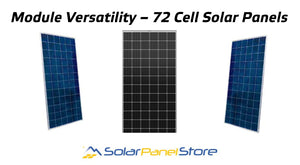

Module Versatility – 72 Cell Solar Panels
Why choose a 72 cell solar panel?- Thomas Lindberg
- Tags: 72 cell Solar Panels


SPS Project Spotlight – Small Hunting Cabin Solar System
SPS Project Spotlight - Small Hunting Cabin Off-Grid Solar System
Yesterday a customer came into our office looking for a nice power solution for his hunting cabin. Initially, he had some questions about a pre-configured portable solar kit that he had noticed online. These plug and play solar kits can be a great choice for particular applications, but after speaking with him for a few minutes, the custom design wheels started to turn in our heads!
After reviewing the customer's expected loads (what he planned to power), showing the customer some solar system components and examples of a few of our off-grid solar charging systems in our warehouse, we were able to get a great idea of exactly what he needed. Keeping low cost and high reliability in mind, our first system design ended up being a 540 Watt pole-mounted system with a 1000W 24VDC - 120VAC inverter. After providing him a quick quote and basic custom wiring diagram, we look forward to the next step with this customer and his installer to see if he would like to look into other options, such as using a larger inverter or possibly an inverter/charger for automated generator use.
As with many off-grid systems, there will probably be a few tweaks to our first design, but we are more than happy to work with our customers until they get exactly what they need and leave with a smile on their face and an extremely reliable system that won't leave them in the dark!
Here's the skinny on what we quoted for this customer, and some notes on what the customer can expect from the system.
Small Hunting Cabin Off-Grid Solar System - Parts List:
QTY: 2 - Peimar 270W 60 Cell Poly Solar Panel SG270P
QTY: 1 - Side-Of-Pole Solar Mount 2X 60-Cell Panel (SOP-Y)
QTY: 3 - HelioLug U Lug PV Lug with Hardware UL 2703
QTY: 1 - 50 ft MC-4 PV Cable Extensions
QTY: 1 - MidNite Solar 3 Circuit Combiner
QTY: 1 - MNEPV 20A PV Breaker
QTY: 1 - MidNite Baby Box
QTY: 2 - MNEPV 30A PV Breaker
QTY: 3 - Two Wire Cable Grip 6mm
QTY: 1 - MidNite Kid 30A MPPT Charge Controller Black MNKID
QTY: 1 - Samlex PST-1000-24 1000W 24V Inverter
QTY: 1 - 2-0 Inverter Cable 48in Red
QTY: 1 - 2-0 Inverter Cable 48in Black
QTY: 1 - Samlex DC-FA-200 Battery Post Fuse Block
Off-Grid Solar System Description.
This is a pretty straight forward 540 Watt 24 Volt system. The two solar panels will be mounted on a side of pole mount from our friends at General Specialties, one of the top-notch U.S. made racking companies we've happily worked with for a number of years. The panels are wired in series, so only a single solar panel extension wire will be required and the panels are fused at the array inside a Midnite Combiner box. The 20A PV breaker is intentionally oversized, the solar panels do have a max series fuse rating of 15A, but here in CO we have seen odd breaker issues in the winter time on pole mounted systems due to the high irradiance and an anomaly we call snow bounce. This 20A breaker is installed inside the Midnite Combiner. Not included in this parts list or wiring diagram, but something that we will also recommend is a lightning suppressor, which would also be installed at the combiner. Our favorite lighting arrester or surge suppressor for this is also made by Midnite Solar, the MNSPD-300-DC.
Wires from the pole will land in the Midnite Baby Box, a handy indoor breaker enclosure, which holds the two 30A breakers for the solar input and output from the MPPT Charge controller. An MPPT charge controller was used not only to step down the voltage from the panels wired in series, but will be better for wintertime production, which is generally when these small hunting cabins are utilized the most. This will feed a 24V battery bank, which the customer currently has but may be interested in upgrading, I'll make some notes below on a couple battery banks that would pair up nicely with the kit.
A 1000 Watt 24V - 120VAC Pure Sine solar inverter from Samlex can power their AC loads, and can either be hardwired to their electrical panel or used standalone with its two standard GFCI receptacles.
A system like this should charge around 1500 - 2700 Watt Hours into the battery each day in the winter time, this is assuming proper panel orientation and 3-5 hours of good sunlight.
We recommended a nice starter battery bank for this cabin solar system that includes four Trojan T105 225Ah 6V batteries. These would be wired in series for a 225 Amp Hour 24 Volt bank, with a total storage capacity of 5,400 Watt Hours.
Off-Grid Solar System - Wiring Diagram
Here's the wiring diagram we worked up for them to give them an idea of how all of the parts work together, we like to keep our parts list in basically the order you see them in our diagrams to make things as easy as possible!

We hope that this customer project spotlight will help inspire your own solar project! Give us a call to explore what kind of custom solution we can provide for you!
Thanks for reading!
- Dan Baldwin
- Tags: Cabin Solar Off-grid Solar